Keynote Address
“RUB at the Frontier: Leadership, Excellence, and Ideas for a New Era”
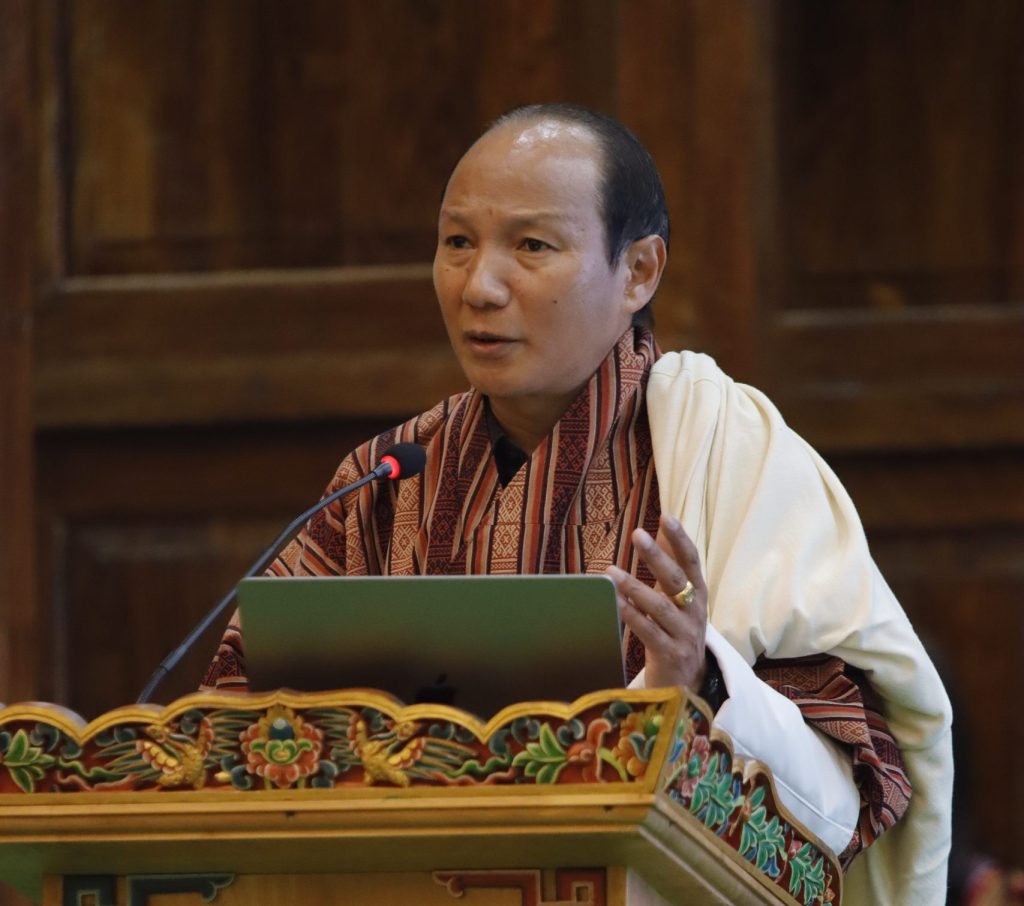
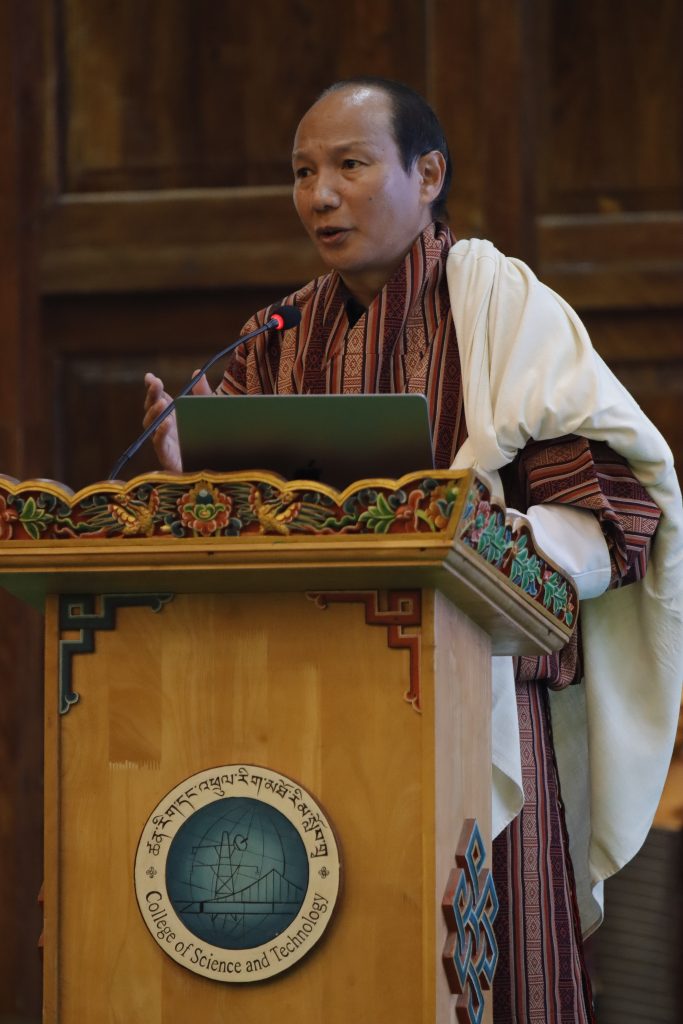
Kuzuzangpo La,
Esteemed Presidents, faculty members from all eleven colleges of RUB,
management and staff of the College of Science and Technology – the host college,
and all viewers watching this event live on social media.
A very good morning and a warm welcome to the first ever Annual Faculty Meet of
the Royal University of Bhutan.
We meet at a moment unlike any other in our nation’s recent history.
Bhutan stands at a crossroads – an inflection point where the choices we make
today will shape not only the next few years, but the direction of our country for
generations to come. Under the farsighted leadership of His Majesty The King, a
bold and deeply consequential national transformation is already underway. His
Majesty has reminded us, repeatedly and with great clarity, that in a world shaped by
rapid technological change, uncertainty, and new possibilities, small countries like
ours cannot afford complacency. Standing still is not an option. Hesitation carries a
cost.
In moments like these, institutions matter.
And universities like us matter most of all, I would like to believe.
Today, the Royal University of Bhutan stands at a frontier of its own – between what
we have been and what we can, and must, become. This frontier is not defined by
geography, infrastructure or budgets alone. It is defined by relevance, ambition,
leadership, and our willingness to rise to the demands of a new era.
The question before us is not whether Bhutan will transform. That transformation is
already underway.
The real question is this:
• Will the Royal University of Bhutan merely adapt to change, or will it help lead
that change?
• Will we try to fit into a rapidly changing national and global landscape – or will
we stand at the forefront of shaping it?
As Bhutan’s largest and oldest university, expectations of us are naturally high. And
rightly so. If we cannot be useful and relevant at this critical moment – when the
country needs ideas, skills, leadership, innovation, and integrity more than ever –
then we must ask ourselves: when will we ever be?
It is in this context that we gather for the inaugural RUB Annual Faculty Meet, and
for A Hundred Ideas Summit. This is not simply a conference. It is a collective
pause. A moment of reflection. And, more importantly, a call to action.
A call for leadership, excellence, and ideas – three cornerstones that will
determine whether RUB truly serves the nation in this new era.
Leadership: From Positions to Responsibility
Let me begin with leadership.
In times of stability, leadership can be routine.
In times of transformation, leadership becomes responsibility.
And in moments like the one we are living through now, leadership becomes a moral
obligation too.
Leadership in a university is not confined to titles or offices. It is exercised every day
– in classrooms and laboratories, in workshops and studios, in offices and in the
field. It is exercised when a faculty member raises standards, challenges
assumptions, mentors a student or a junior faculty, collaborates across disciplines, or
asks difficult but necessary questions.
The 21st century demands a different kind of leadership from universities.
• Leadership that is adaptive, not rigid.
• Collaborative, not hierarchical.
• Grounded in purpose, not procedure.
Globally, universities that matter today are those that anticipate change rather than
react to it; those that connect knowledge to real societal challenges; and those that
produce graduates who understand the context, can think critically, lead ethically,
and adapt continuously.
For the Royal University of Bhutan, leadership must be exercised at every level. It
cannot rest only with those formally designated as leaders, such as our Presidents or
Deans, but must be embodied by every faculty member who understands that their
daily work shapes minds, values, and futures. In that sense, each one of us is called
upon to be a role model.
This in no way diminishes the critical role of institutional leadership. On the contrary,
Presidents and senior leaders carry a special responsibility – to set direction, to
model professionalism and excellence, and to shape a culture where leadership of
the self, accountability, and high standards become the norm. When leadership at
the top is clear and principled, it creates the conditions for leadership to flourish
across the University.
As His Majesty has emphasised, Bhutan cannot afford incrementalism at this stage
of our national journey. The same is true for our University. Leadership today means
having the courage to let go of outdated practices, to challenge comfortable norms,
and to move beyond the mindset of “this is how we have always done things.”
Leadership also means collaboration. No single college, discipline, or individual can
respond to today’s challenges alone. The problems before us – whether in
education, sustainability, technology, governance, or wellbeing – are complex and
interconnected. They require interdisciplinary thinking and institutional coherence.
This Annual Faculty Meet itself is an act of collective leadership. It signals our
willingness to come together as one University, to listen to one another, and to take
shared responsibility for where RUB goes next.
Excellence: Raising the Bar, Not the Rhetoric
RUB aspires to be a global beacon of enlightened education, research and
innovation, and without the intentional and consistent pursuit of excellence, our
vision will only remain an aspiration.
Excellence is often spoken of, but far less often pursued. It is sometimes mistaken
for perfection, or reduced to comparison with others. In reality, excellence is neither
static nor superficial. It is a mindset, a discipline, and a culture. Above all, it is a daily
choice – to do our work with conscience, care, and conscientiousness with full
awareness of the context in which we live and operate.
In higher education today, excellence is judged less by claims and more by impact.
• Are our graduates prepared for a rapidly changing world?
• Is our research addressing real societal needs?
• Are our teaching methods aligned with how students learn today?
• Are our institutions agile, ethical, and forward-looking?
For RUB, excellence must be both contextual and aspirational. We must remain
deeply rooted in Bhutanese values – such as integrity, compassion, sustainability,
and community – while also benchmarking ourselves against the best in the world.
This requires honesty.
Excellence demands that we look honestly at ourselves and at our practices. It
requires us to ask difficult, sometimes uncomfortable questions.
• Are we content with what is merely acceptable, or are we prepared to raise
the bar?
• Do our curricula reflect the knowledge, skills, and mindsets our graduates will
need in the future?
• Are we seriously imparting the values of tha-dam-tse and ley-ju-drey to our
students and modelling them ourselves?
• Are our systems enabling innovation – or quietly constraining it?
• And are we truly investing enough in faculty development, research culture,
and academic leadership to sustain excellence over time?
Excellence cannot survive in isolated pockets. A few outstanding individuals or
programmes are not enough. For excellence to endure, it must be systemic –
embedded in our policies, incentives, expectations, and everyday ways of working.
This requires consistently striving for high standards, taking personal responsibility
and accountability, embracing continuous learning, and having the humility and
maturity to learn from failures. Only when these become institutional norms and an
integral part of our culture, can excellence truly thrive. That is why the University has
adopted excellence as one of its core values.
Ultimately, excellence begins with us as faculty members. It is reflected in how we
prepare for our classes, how we assess learning, how we mentor students, how we
pursue research, and how we engage with society beyond our campuses. These
daily choices, often unseen, are what give real substance to the idea of excellence.
The students who pass through our classrooms today will shape Bhutan tomorrow.
The standards and the values we uphold – or fail to uphold – will echo far beyond
this University, long after we have moved on. That is the weight, and the
responsibility, of excellence.
Ideas: The Currency of the Future
In the 21st century, ideas are a form of currency. They drive innovation, shape
policy, transform institutions, and redefine possibilities. Universities exist,
fundamentally, to generate, test, refine, and transmit ideas.
The Ideas Summit is founded on a simple but powerful belief: <strong>that the collective
wisdom, creativity, and experience of our faculty is our greatest asset.</strong>
Across our colleges lie deep insights into what works well, what needs to change,
and what new possibilities we can imagine for learning, teaching, research,
innovation, governance, and global engagement. Too often, these ideas remain
localised or unheard.
This Summit is designed to change that.
Over the next few days, you will work in diverse, inter-college groups to identify real
challenges and propose concrete solutions. You will test your ideas through
dialogue, peer feedback, and collective assessment. You will refine them—not as
abstract concepts, but as actionable proposals.
This matters.
Because ideas that truly matter are not just bold. They are feasible. They are
grounded in context. And they are owned by people willing to carry them forward.
“Let me be clear: the success of this Summit will not be judged by the number of
ideas we generate, but by what we do with them. Real success lies in how many
ideas are taken seriously, developed further, and translated into action. This is where
leadership across our colleges – and the commitment of all staff – becomes critical.
We will select the top five ideas, as required by the format of the Summit. But
selection of the top five ideas should not be mistaken for permission to ignore the
rest. Many ideas may be modest or locally relevant, yet still capable of improving
how our colleges and the University function. Wherever ideas are feasible and
aligned with our priorities, we must put them to work. That is a responsibility we all
share beyond this Summit.
RUB’s Responsibility in a Transforming Nation
Let me step back to the larger picture.
Bhutan’s transformation—whether through initiatives like the Gelephu Mindfulness
City or broader national reforms—demands knowledge, skills, ethical leadership, and
innovation. These cannot simply be imported. They must be cultivated at home.
This places a profound responsibility on the Royal University of Bhutan.
We are not observers of national change. We are stakeholders. Our relevance will
be judged by how well we contribute to national priorities and what value we add –
whether in human capital development or in research and innovation to shape
policies and drive growth.
If we cannot rise to this responsibility now—when the country needs us most—then
we risk becoming spectators in a transformation that demands our participation.
And yet, I am deeply optimistic.
Across RUB, I see talent, commitment, and quiet excellence. I see many faculty
members who care deeply about their students, their disciplines, and their country. I
see immense potential to reimagine what a Bhutanese university can and should be
in the 21st century.
What is required now is alignment – of purpose, effort, and ambition.
Stepping Forward Together
Let me conclude with this.
The frontier we stand at today is not distant. It is right here. It is defined by the
choices we make – in our classrooms, our research agendas, our partnerships, and
our institutional culture.
• Leadership is not optional.
• Excellence is not negotiable.
• Ideas are not a luxury, they are a necessity.
This inaugural Annual Faculty Meet, I’m sure you all will agree, is a milestone. It sets
the tone for what follows. Future editions will evolve in theme and format, hosted by
different colleges, shaped by collective learning. But this first one matters deeply. It
signals who we are – and who we aspire to become.
As distinguished faculty members of the Royal University of Bhutan—and I
emphasise the word distinguished, we carry both privilege and responsibility: the
responsibility to shape the future of this University, and through it, to serve our nation
in the way His Majesty The King and the people of Bhutan rightly expect of us.
Let us engage fully in this Summit – with curiosity, openness, and a spirit of
collaboration and contribution. Let us listen to one another, challenge one another,
and support one another. And in the process we reconnect, forge new friendships
and strengthen our shared sense of identity, purpose and direction as members of
the Royal University of Bhutan.
The Royal University of Bhutan stands at the frontier, and the frontier is before us –
there is no looking back. Let us step forward together: exercising sincere and
authentic leadership, pursuing enduring excellence, and generating the insights and
ideas our University needs to succeed in this new era.
Finally, I would like to express my sincere appreciation to the President, the
management, and the entire faculty and staff of the College of Science and
Technology for their commitment and hard work in hosting this inaugural RUB
Annual Faculty Meet. Their efforts have created the conditions for a meaningful and
productive Summit over the coming days, and have set a positive tone for what we
hope will become a strong and enduring annual tradition in our University. I wish to
place this on record, because I know how much care, time, and effort have gone into
preparing for this gathering.
Similarly, I would like to express my sincere appreciation to all Presidents and faculty
members across the University for your unwavering support and cooperation – not
only in making this inaugural RUB Faculty Meet possible, but also in supporting,
guiding, and encouraging me throughout my first year as Vice Chancellor.
I wish you all a meaningful, engaging, and memorable three days together at this
Summit.
Thank you and Tashi Delek.